

Interview: Penny James, Direct Line Group
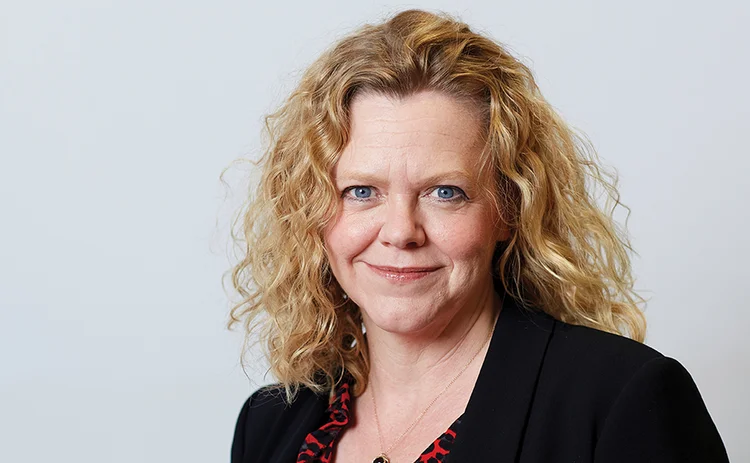

Direct Line Group CEO Penny James spoke to Jen Frost about overseeing the business’s transformation programme under coronavirus, the group’s acquisitive appetite and having a healthy curiosity
CV
2019 to present
CEO
Direct Line Group
2017 to May 2019
Chief financial officer
Direct Line Group
2017 to 2019
Chief risk officer
Prudential
2014 to 2017
Non-exec director
Admiral
2011 to 2017
Director of group finance
Prudential
2007 to 2011
Chief financial officer
Omega Insurance Holdings
2004 to 2007
Chief financial officer, UK general insurance
Zurich
Direct Line Group head honcho Penny James speaks to Post from her home in Hampshire, due to – as she describes it – the “strange spell” UK businesses are experiencing under the coronavirus pandemic.
The insurer has a few people back in its offices, but as seems to be the case across the country, things are moving “very slowly at the moment”, James confirms.
The new way of working appears to have its benefits; James – who hails from the West Country – says she was able to spend about a month in Cornwall over the summer where she was closer to family.
“All my family seems to be down there and I’m here on my own, which is a bit like being Billy no mates,” she jokes.
James has shunned your typical CEO suit for the interview. Indeed, she appears to have embraced the slightly more casual dress code that working from home has enabled across much of the insurance world.
James confesses with a smile: “I went into the City this week and I couldn’t bear to put City clothes on, so I went in a dress because I was so out of practice.”
The DLG boss was revealed as Paul Geddes’ successor in February 2019, having taken over as the insurer’s chief financial officer in March 2018.
Her curriculum vitae boasts senior roles at big insurers. James started out in accountancy, working with a “variety” of clients from Bristol.
“I just found insurance was more interesting,” James explains when asked how she ended up in the industry.
She adds: “Some of that is the complexity, some of it is the humanity of it. It has a real purpose in itself. Some of that, as ever, is just the people that you meet.”
Since joining the industry she has worked as Zurich UK’s chief financial officer and Prudential’s finance director and chief risk officer. From 2015 to 2017 she was also a board member of Admiral.
“I’ve learned a huge amount on the way,” James says. “Being a finance person is a really powerful way to learn in any sector, largely because you get to see your whole of the organisation from different perspectives.”
James says she would “encourage anyone” to spend some time in a risk role, describing it as a “great grounding”. The Covid-19 pandemic has hit home how helpful the role was for her professional development.
She says: “Being the risk person on the board at the Pru was a fascinating role. Little did I know how important it would be that a year in from becoming CEO, I’d be exercising in one of the biggest risk environments we’ve come across.”
Not your typical CEO
Fast-forward to today and James has been in the DLG role for around a year, at the helm of a £3.2bn gross written premium insurer and some of the best-known insurance brands in the UK. She became the seventh female CEO on the FTSE 100 when she took the top job, the provider having since slipped into the FTSE 250.
When Post spoke to former colleagues about James before she took on the role, she was described as “not your typical CEO type”, motivated by solving problems more than status or money.
James describes herself in similar terms – and freely admits that when she started out: “I assumed that I would become a housewife somewhere along the line. I didn’t start with this burning ambition to get to the top. I just never challenged the assumption that was around me.”
According to James: “Nothing quite prepares you for becoming a CEO. People will look at you and respond to you differently. Even though you feel that you haven’t changed, your situation relative to them has so it’s always quite a shift.”
Rather than being driven by a desire to be a CEO, James says, she has been propelled by a “curiosity about what experiences you can build”.
“What’s interesting and what’s not? Why do people do what they do? I’m fascinated by how teams work together and what it is that drives them, and what’s good and what’s bad? I really never run out of interest for learning and trying and experimenting with these things,” she explains.
She adds: “If I had a tip for people it’s that I decided I would try do each job in about half the time. If you do that it forces you to hire great people and means you never get bored because there’s always something more interesting to go for. Then when the interesting project comes up, you’re the person that says, I’d really like to do that and I’ve got capacity to do that, because my team have got it covered.”
James identifies “being easy to work with” and being “able to get stuff done” as the two characteristics she advises people to work on if they want to be successful within an organisation.
However, she caveats this: “Organisations need to get better at looking beyond the usual suspects to give the great projects to because that’s what reinforces some of the diversity inadequacies that we have.”
Penny James on…
The Financial Conduct Authority’s business interruption test case: Nearly all of our policies were sufficiently tightly worded. They were never caught [up in the test case]. The test case was trying to test a spectrum of words. But it tested a spectrum of wordings believing the line would be somewhere in the middle. Ours were right at the end of the spectrum so we’re not subject either to the test case itself or the list of policies that were declared on the website that were covered.
We have two scheme arrangements that are but we had decided that we would pay out on those in full and have been doing so. So there’s no impact [to us from the test case]. We did our estimate at £10m [from BI claims].
From my perspective, it is good for the industry that we get through this phase. While it’s a case that is really about testing contract law and understanding the complexities, for our customers and for the industry this being behind us and moving on is a good thing.
Black Lives Matter and the Churchill brand: We have no plans to change the [Churchill] brand name. Whatever the history there, for us it is associated with Churchill the dog and it is known brand within insurance for what it is, so no plans at the moment.
In terms of Black Lives Matter and the issues there, we’ve thought long and hard about that. For me, the most important thing is that we’re setting cultures within our organisations that enable people to flourish and feel included whoever they are and whatever their background. Like many people, the learnings of the last few months are [challenging] some of our assumptions.
Direct Line has been very aligned to the diversity and inclusion agenda for many years. The conversations over the last few weeks around BLM really brought home some of the issues that individuals face. We’re doing a lot of work internally on diversity and inclusion, trying to understand what people’s real experience is in the organisation.
Dual pricing and insurers: All the CEOs I speak to are supportive of the Financial Conduct Authority looking at it. Given competition law it’s very difficult for the industry to sort it out on its own. And because it’s an issue that derives from competition, because it’s a super competitive market and a super transparent market, people are loss leading. That leads to pricing pieces over time. When I talk to CEOs, most of us believe that we’d hope to get to a better and more even model.
It is devilishly complicated to work through. So I don’t envy [the regulator] that task.
How shareholders view dual pricing: Investors don’t like uncertainty. They like things that they can think through and put a quantification around, and they don’t mind making their own judgement on that that quantification. Something like this with so much uncertainty is quite difficult for shareholders, so it has an impact on the market for the bigger players in that sense. Shareholders will be glad to understand what it means.
Motor refunds during Covid-19: What we chose to do was look after first and foremost customers who are in financial difficulty. Whether it’s payments payment deferrals or changing cover for them. A lot of coverage needs have changed. Making changes or cancellations on mid-term amendments. Discounts, you name it, all sorts of things.
We also told every customer and marketed heavily that we will put whatever mileage you want us to and you can change it retrospectively. For us that feels like a much more like a sustainable approach so customers can choose and tell us how their life is changing and we can come back to this concept of making insurance tailored to the individual so that it works for you.
Balanced leadership
Speaking as a female FTSE CEO, James highlights: “It’s really important, not just across gender, to [get to a more balanced leadership] across businesses. If you look at insurance we have a long way to go. We are miles away on gender, even more so on ethnicity.”
Hobbies
- Friends
- Family
- Walking
Places worked
- London
- Bermuda
Three words to best describe her
- Positive
- Honest
- Curious
She identifies a “couple of beacons”.
“If you look at the number of female CEOs in the FTSE 350, and then look at how many of them are insurance, you kind of go: What? That’s not so bad. It’s fantastic that Amanda [Blanc, Aviva CEO] recently joined that list. Milena [Mondini de Focatiis, Admiral CEO designate] this year as well. There are a number of names there, which is really good to see. That is by no means enough or the end of it but it is huge progress.”
As to the progress James herself is making in charge of DLG, she points to the business’s transformation plan, which is “getting towards the latter stages”.
In February the provider announced 800 jobs were at risk by 2022, James now putting this figure at 700, with closures of its Ipswich operations and a material reduction at its Manchester premises as part of the technology-led plan, though it put a moratorium on job losses until this Autumn due to the coronavirus pandemic and at the time committed to providing 12 months’ notice.
“Fundamentally those plans haven’t changed,” James says. “They weren’t scheduled [to take place this year], we would give a minimum years’ warning to colleagues so we can work with them, whether for internal redeployment or retraining or placing externally.”
Changing behaviour means the provider has seen employee attrition levels “drop like a rock”, James says. “It’ll be interesting to see, as we go across Autumn, how that develops.”
James adds the very sudden changing nature of work offers a “real opportunity to look at how we use premises and buildings” and create a “more flexible set up”.
Across the transformation plan, while Covid-19 has meant “a couple of things have been delayed”, James points to the roll out of a cloud-based accounting system, which she describes as a “huge thing” as it is used to pay every claim across the business. The Green Flag claims system has also had a revamp, and has upgraded the telephony system across the company, along with “several other big drops” on the transformation path.
James adds the company is now asking: “How do we set ourselves up around those to make sure that we leverage the tools that we that we’ve spent a lot of money on introducing?”
At 35 years young, James believes the business might already have had its mid-life crisis “along the way”.
She says: “It had a difficult spell when it was owned by RBS in terms of investments, and that set it back some years. We would say now that we missed the turn of price comparison sites. As is often the case for the company that’s got a really strong hold in a particular way and it’s disrupted. For whatever reason, the company at the time refused to believe that price comparison would play as strongly.”
Now, James says: “I want to be in a position that we can play [well in] direct distribution but we can also be successful in price comparison as well.”
What is the biggest challenge facing the industry?
The long term challenge is for it to evolve into a world of rapid technological shift. By which I mean use of data to a completely different degree. Car technology is driving data and changing the profile and risk of claims as well.
Above all, being able to play and grasp that race, and actually influence some of those things to make sure that we have got a form of industry to operate in because some of those things are such fundamental changes. That is probably the biggest single challenge.
Here and there are lots of other things. It’s very clear we still have work to do on customer trust. I see lots of people who want to do the right thing by customers, and I see CEOs who want to do the right thing, and are looking at what they can do. But still there’s a trust gap and an understanding gap we have to close. And finally, whether you’re in insurance or not, we all have a climate challenge to address.
Household names and new brands
DLG’s price comparison brand Churchill is already a household name but new brand Darwin, which had sold 30,000 policies from launch to the end of the first half of 2020, is the group’s latest aggregator play. James describes Darwin “as an additional play in the price comparison sites to see if we can use machine-learning techniques to build its own powerful pricing model in that space”.
Meanwhile rival Aviva has said it will now bring the Aviva brand to PCWs. For now it seems there are no plans to follow in Aviva’s footsteps. James adds: “Direct line is, as it says on the tin, is our direct brand, and Churchill is our leading price comparison site brand. So we’re in a slightly different position, and I believe both channels will be successful in different ways.”
DLG has this year hinted it could look to grow by buying businesses as well as organically.
It recently completed the purchase of insurtech Brolly, which has been described as an ‘insurance concierge’. Brolly CEO Phoebe Hugh is expected to stay with DLG.
“What Brolly does is all about personalised, tailored products,” James says. “I hope it believes that we’ll have depth of experience, background and brands that it can work extensively with. From our perspective, it’s a great innovative team that we can plug into that new structure that we’re doing and we hope can accelerate that strategy for us.”
Describe the culture at Direct Line Group
When you walk in what strikes you is that staff care about people and customers so those two things naturally go together. It’s very open in terms of communication so I regularly speak to 3000 people on a phone call and they will ask me all sorts of questions about anything they want to, and seem pretty relaxed in doing so. It is very open in that sense. It’s an organisation that grabs things that are people-centric, so the mental health agenda is [something that is looked at a lot] because there’s a huge movement behind it within the organisation. What really comes through is a passion for looking after customers. That’s from well before I came on board so I can’t take credit for that. But it’s an amazing thing to have at the heart of your organisation. The job for me is to turn that into something that we can use commercially really successfully.
Eyes on insurtech
On the insurtech space, James says: “We keep our eyes open, in that space, because […] there are always sort of limitations on investment priorities in a larger organisation. In particular with the brands we’ve got, some of the capabilities we’ve got, there are opportunities to plug into that.”
The company has investments in autonomous vehicles firm Five AI, as well as in telematics business The Floow.
As to bigger ticket acquisitions, James says: “Broadly there’s a couple of spaces that that we’ve said we’re open minded to. You only ever have what there is available, it’s a two-sided thing.”
However, she adds: “My first and foremost priority is always on the organic strategy because we think it works and we’ve got lots to do. But we keep our eyes open and there’s clearly lots of activity out there at the moment, which is quite entertaining to watch.”
For now, the priority remains growing at home, across its current direct and PCW brands and broker-focused NIG, which James describes as a “great business”.
“As a business we’re unlikely to do a significant expansion overseas,” James says. “Insurance largely is dominated globally by some really strong local players. If you look in the US or Canada there’s some great businesses. I’m not likely to take them on. If you go across Europe, I’m unlikely to successfully take Allianz on their home territory. We can be brilliant in the UK and that’s what our core is all about.”
What is the industry doing well?
We do a couple of things really well. Generally most companies, not all but most of the big companies, do a good job to customers, both at the point that the claim and [otherwise]. We’ve come a long way in that regard. We shouldn’t forget that we operate probably the most sophisticated insurance market on the planet. Personal lines insurance in the UK is a very sophisticated beast.
There aren’t many places where you can pop onto a price comparison site or ping up Direct Line, or whatever, and have quotes across the industry in seconds. In terms of transparency we’ve created a very transparent market so there are lots of things that we do well and plenty of things that we need to work on.
Only users who have a paid subscription or are part of a corporate subscription are able to print or copy content.
To access these options, along with all other subscription benefits, please contact info@postonline.co.uk or view our subscription options here: https://subscriptions.postonline.co.uk/subscribe
You are currently unable to print this content. Please contact info@postonline.co.uk to find out more.
You are currently unable to copy this content. Please contact info@postonline.co.uk to find out more.
Copyright Infopro Digital Limited. All rights reserved.
As outlined in our terms and conditions, https://www.infopro-digital.com/terms-and-conditions/subscriptions/ (point 2.4), printing is limited to a single copy.
If you would like to purchase additional rights please email info@postonline.co.uk
Copyright Infopro Digital Limited. All rights reserved.
You may share this content using our article tools. As outlined in our terms and conditions, https://www.infopro-digital.com/terms-and-conditions/subscriptions/ (clause 2.4), an Authorised User may only make one copy of the materials for their own personal use. You must also comply with the restrictions in clause 2.5.
If you would like to purchase additional rights please email info@postonline.co.uk
More on Personal

Insurers raise record-breaking £529K for Alzheimer’s Society
The ninth Insurance Day for Dementia, held yesterday (26 November), has raised a record-breaking £529,157.19 and counting for Alzheimer’s Society, up from last year’s £436,000 fundraising total.
Winn targets growth in telematics and dispute resolution
Winn Group is pushing for growth in two areas of its business leading into 2027, CEO Chris Birkett has told Insurance Post.

Deer-vehicle collisions reach six-year high
Deer-vehicle collisions have reached their highest level in six years during the autumn rutting season, according to AA Accident Assist.
Tara Foley to step down as Axa UK and Ireland CEO
Tara Foley has revealed she is stepping down as CEO of Axa UK and Ireland after six years.

Credit hire costs to peak amid inflation forecast
Credit hire costs are set to rise significantly over the next three years, putting further pressure on motor insurers, according to QG Law.

Why electronics retailers are turning to embedded insurance
How embedded protection can give electronics retailers a new revenue stream while helping them stay connected to customers beyond the initial sale is explored by Ross Sinclair, founder and CEO at EIP.
Aviva enters pet insurance space with lifetime product launch
Aviva has entered the UK pet insurance market with a new lifetime product, Insurance Post can reveal.

60 Seconds With... EY’s Kevin Gill
Kevin Gill, strategic transactions and restructuring partner at EY-Parthenon and chairman of the Insurance/Reinsurance Legacy Association, reveals how a broken leg led to a secondment into a team running off insolvent insurance companies.