
How 9/11 still shapes insurance
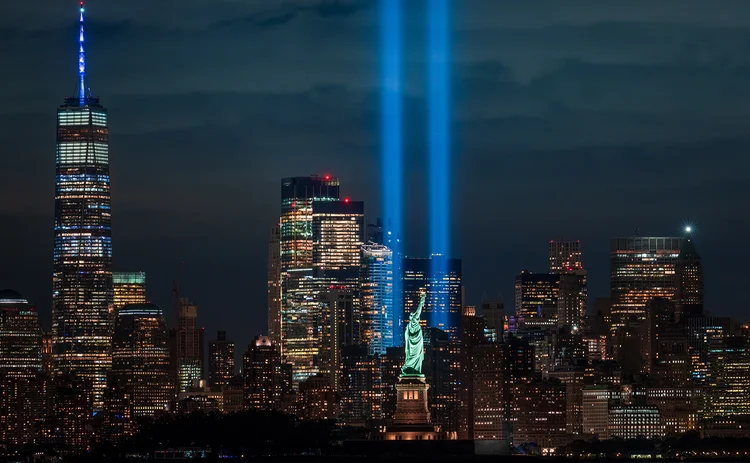

Editor’s View: On the 25th anniversary of 9/11, Emma Ann Hughes reflects on how the attacks changed terrorism risk, catastrophe modelling and insurance capacity forever and reminds the sector of how it must always help people recover from loss.
At midday today (9 September), I will be standing on Lloyd’s Underwriting Floor for a memorial service marking 25 years since the September 11 attacks.
There is something fitting about remembering 9/11 at Lloyd’s. The London market was changed profoundly by the attacks, but so too were the people who worked within it.
While the attacks were first and foremost a human tragedy, the terrorist plane hijackings carried out by al-Qaeda against the US changed the business of insurance in ways that still shape the market today.
Only those aged more than 30-years-old now remember watching the tragedy unfold on BBC1 that day.
I was at my parents’ home, in my childhood bedroom with a high temperature. My mother came in to tell me to turn on the television as the North World Trade Centre in New York was on fire.
Insurance Post’s publisher lost 16 colleagues, who were hosting a conference at Windows on the World, along with 71 attendees. These are not simply numbers attached to an insurance loss. They were colleagues, friends, parents, children and partners. Every claim generated by 9/11 ultimately represented somebody whose life had been ended or changed.
The world – including BBC News presenters – didn’t know at the start that American Airlines Flight 11 had struck the North World Trade Centre, but everyone watching was aware thousands of people were inside a burning high-rise building.
I remember the shock when we saw United Airlines Flight 175 hit the South Tower in real-time and knew we were watching, live, an attack that would become the deadliest on US soil since Pearl Harbour.
The shockwaves were overwhelming. Watching people hanging from windows, trying to escape the fire, some falling from the building; reports the Pentagon had been hit; another plane had crashed that could have be on the way to Washington; the Twin Towers collapsing; the streets of New York filling with smoke and debris.
What is harder to convey, 25 years later, is the human reality behind those images.
Nearly 3,000 people were killed. Thousands more suffered physical injuries and, in the years that followed, many more faced long-term physical and mental health consequences from the toxic dust, smoke and debris.
The extraordinary bravery of firefighters, police officers, emergency workers and ordinary people who tried to help others remains one of the defining memories of that day. People running towards the danger to help.
Unlike a Hollywood disaster movie before 9/11, where often someone would become hysterical, there was calm resolve even though there was no guarantee a hero would survive or certainty about what would happen next.
These were real people trapped in real buildings, and people making split-second decisions to try to save them.
For many in the insurance industry, the tragedy was deeply personal.
Marsh and Aon, both represented at today’s Lloyd’s memorial service, had offices in the World Trade Centre and lost hundreds of colleagues and consultants.
Insurance Post’s publisher lost 16 colleagues, who were hosting a conference at Windows on the World, along with 71 attendees.
These are not simply numbers attached to an insurance loss. They were colleagues, friends, parents, children and partners. Every claim generated by 9/11 ultimately represented somebody whose life had been ended or changed.
It is important that those losses are never reduced to statistics. Because this, ultimately, is what insurance is about: people.
Reassessing risk
A lot has been written about how 9/11 changed the way the insurance industry understood risk.
Before the attacks, terrorism was generally regarded as a relatively remote peril. It was not comprehensively modelled in the way insurers had become accustomed to modelling earthquakes, hurricanes and other natural catastrophes.
September 11 changed that overnight.
While the physical footprint of the attacks was concentrated, the insurance consequences spread across multiple classes of business.
Property losses were accompanied by aviation, workers’ compensation, business interruption and other claims.
The event demonstrated that a single catastrophe could trigger losses across lines that had previously been assessed with far less emphasis on their correlation.
For Lloyd’s, it was the largest single loss the market had faced.
The lesson was not simply that terrorism needed to be priced differently. It was that insurers needed to understand how a deliberately engineered catastrophe could exploit connections between once seemingly separate risks.
That thinking helped drive the development of more sophisticated terrorism risk modelling and accumulation management.
Underwriters increasingly needed to ask not only where an insured asset was located, but what else could be affected by an event.
Terrorism became a risk to be modelled, accumulated and actively managed.
It also became a risk that the private insurance market recognised it could not necessarily carry alone.
The immediate response following 9/11 included widespread terrorism exclusions and a reassessment of available capacity.
In the US, the creation of the Terrorism Risk Insurance Act in 2002 established a federal backstop for large-scale terrorist attacks, reflecting the recognition that public-private cooperation was necessary.
In the UK, Pool Re – created in 1993 following a wave of attacks by the IRA including the 1992 Baltic Exchange and Bishopsgate bombings – also evolved in response to the changing terrorism threat.
Pool Re today encompasses a broader range of terrorism scenarios, while its risk-management work includes catastrophe modelling, accumulation analysis and disaster scenario planning.
This shift was important as the dispute over whether the destruction of the Twin Towers constituted one insured occurrence or two exposed the dangers of the industry’s “deal now, detail later” culture.
If policy language had been finalised and agreed before the attacks, that uncertainty would not have arisen.
Insurance ultimately depends on promises made before a loss occurs. The value of those promises is tested when circumstances are at their most difficult.
Threat landscape today
Twenty-five years later, the terrorism threat has changed.
The industry is no longer dealing with precisely the same threat landscape it faced in 2001.
Terrorist organisations, methods and targets have evolved, while cyber-attacks, assaults on critical infrastructure, supply-chain disruption and other forms of systemic risk have introduced new questions about the waves created by an event.
But as I prepare to head to Lloyd’s memorial service, I feel the lessons the sector learned in the wake of 9/11 remain remarkably relevant.
The industry’s response to 9/11 cannot simply be remembered as a historical chapter in catastrophe modelling. It was a fundamental change in the way insurers think about interconnected risk.
Yet as we gather today at Lloyd’s, the most important thing that brings tears to my eyes is not the modelling, the capacity or even the contracts. It is the people.
We remember those who were lost, including the many from the insurance industry.
We remember the physical and psychological effects of 9/11 that have continued for decades, affecting survivors, responders, residents and workers.
We remember how 9/11 showed risk that once seemed unthinkable can become reality in an instant.
The industry’s responsibility is to be ready when it does and to provide the financial support, certainty and resilience that people and businesses need when their lives are turned upside down.
Risk models, contracts and capacity all matter but they are means to an end.
Behind every risk is a person, and behind every insurance policy is a promise to help.
Only users who have a paid subscription or are part of a corporate subscription are able to print or copy content.
To access these options, along with all other subscription benefits, please contact info@postonline.co.uk or view our subscription options here: https://subscriptions.postonline.co.uk/subscribe
You are currently unable to print this content. Please contact info@postonline.co.uk to find out more.
You are currently unable to copy this content. Please contact info@postonline.co.uk to find out more.
Copyright Infopro Digital Limited. All rights reserved.
As outlined in our terms and conditions, https://www.infopro-digital.com/terms-and-conditions/subscriptions/ (point 2.4), printing is limited to a single copy.
If you would like to purchase additional rights please email info@postonline.co.uk
Copyright Infopro Digital Limited. All rights reserved.
You may share this content using our article tools. As outlined in our terms and conditions, https://www.infopro-digital.com/terms-and-conditions/subscriptions/ (clause 2.4), an Authorised User may only make one copy of the materials for their own personal use. You must also comply with the restrictions in clause 2.5.
If you would like to purchase additional rights please email info@postonline.co.uk
More on Commercial

Fraudster fails to pull wool over Ifed’s eyes
City of London Police’s Insurance Fraud Enforcement Department is investigating suspected fraudulent insurance claims over the alleged theft of more than 650 sheep.
What next for Aviva and insurance’s greatest Dame?
Editor’s View: Emma Ann Hughes considers the remarkable turnaround of Aviva under Dame Amanda Blanc and asks what comes next for the insurer and its formidable group CEO.
Throwback Thursday: Royal retreats from Moscow
Insurance Post’s Throwback Thursday steps back in time to October 1991 to remind you what was going on this week in insurance history when Royal International was reconsidering its plans for a Moscow-based insurance company.
Q&A: Nick Dinsdale, Peach
Nick Dinsdale, underwriting director at Peach, speaks to Insurance Post about the firm’s new hire, AI in underwriting and Peach’s growth plans.

CFC report highlights gap in cyber awareness and understanding
Research from CFC has found that while SMEs are aware of the threat of cyber-attacks, most misunderstand the threats they face and the protection cyber insurance provides.

How AI is redefining the art and science of underwriting
As artificial intelligence adoption expands across underwriting, Marcel Le Gouais examines how a more complete picture is emerging of where automation ends and human judgement remains.
Big Interview: Simon Hunt, HDI
Simon Hunt, CEO of HDI UK and Ireland, reveals how he is looking to grow the corporate and specialty lines insurer by launching a new Lloyd’s syndicate and expanding in areas including energy, cyber and healthcare.
Penny Black’s Social Diary: Aviva’s trams and Earnix’s sushi
Penny Black has been out and about again, notebook in one hand and canapé in the other, keeping a keen eye on the insurance industry’s more whimsical moments.