

Broking supplement - Price promises: Love it or hate it


While the price promise bandwagon is seen by some as a valuable marketing tool, to others it is merely ‘dumbing down’ the industry
The ‘guarantee to beat’ initiative is by no means a new phenomenon — yet, with a steady trickle of firms ready to clamber aboard the price promise bandwagon, industry insiders are beginning to raise question marks over the value such schemes bring to the business consumer.
Almost two months after wholesale property broker Keelan Westall announced it was going to beat premiums by 10% for commercial property risks over £500 until the end of the year, Post Office business insurance bosses have now become the latest to wise up to this perceived ‘marketing tool’ by offering the best deals on renewal quotes for solicitors’ offices where annual premiums exceed £238.50.
However, market reaction to price guarantees has rarely been entirely positive and it appears that little has changed in terms of industry attitude since the start of the year when NIG was branded “reckless” and “naïve” by key commercial insurance players following the company’s initiative promising to undercut 15 major insurers by 5% on its latest products range.
Responding to the NIG promotion in February this year, Brokerbility chairman Ashwin Mistry expressed concern over the long-term viability of the price match model, saying: “This is exactly what insurers don’t need; brokers and insurers are trying to talk rates up. This shows naivety that it believes brokers choose purely on price.”
Fast-forward eight months and Mistry’s stance has hardened as he believes this is undermining the professionalism of the industry: “This is an approach that comes with the concern that we’re going to just end up commoditising everything. We have seemingly reached a stage where cheap and cheerful products have become more palatable to consumers and they are now more willing to barter for their premiums, which is not a good thing.
“Everybody talks about creating an environment of a profession rather than just a trade, but this sort of activity just goes to undermine that approach. Where have the underwriting principles gone?”
When asked for his view on the future of similar price promotions, Hiscox underwriting director Gary Head explains that if an increasing number of firms begin to operate in this way then the inevitable conclusion would be to provide cover free of charge: “In reality, the market has always competed on price but this underplays the value proposition for clients. ‘Dumbing down’ the value of insurance is very damaging for the market as a whole, particularly in a soft market.
“With claims increasing in a number of areas and investment returns at an all time low, companies have a simple choice to make – put up rates or lose more money. The logical end point for an infinite ‘beat the quote’ promotion is to give the cover away for free, so in the long run it is not sustainable.”
Mistry is equally scathing in his assessment of the situation. “This practice is simply not sustainable and to be perfectly frank our forefathers would be turning in their graves if they could see how some within the industry are choosing to operate below the cost of trading.”
Furthermore, benefits for the consumer seem to be limited as well. What the man in the street may initially view as a bargain may, in many instances, equate to a poor choice of product – the message being that low cost rarely includes required quality.
Simon McGinn, Allianz Commercial broker markets director, explains: “Consumers are getting a pretty good deal at the moment, but how long is that going to last? There is clearly a huge amount of short-termism at play and that is ultimately bad for the consumer.”
Destabilising influence
Jonathan Davey, Keychoice director, echoes this sentiment, describing the practice as “shooting ourselves in the foot”. He adds: “Underwriting for volume and cutting price is helping to fund-amentally destabilise the general insurance market.
Brokers that adopt this price guarantee are not necessarily offering a good service. Cheap is not always best; customers want stability, not boom and bust. The whole thing plays directly into the hands of the aggregators.”
Fears that customers could be hit hard after subscribing to reduced rates one year, simply to be left facing hefty price hikes the next, is something Head insists should be taken seriously, claiming that the prevalent beat-that-quote mentality is one which is “fraught with danger”.
He explains: “Treating customers fairly is at the heart of this issue. As an industry we need to ensure the customer gets the product and claims experience they expect and they are not left disappointed. Unfortunately, cheap premiums often come from restricted covers and the question has to be whether the customer understands these restrictions when they first buy the product.
“It is a path fraught with danger for both brokers and customers. Like many things in life, you get what you pay for with insurance and if you go for the cheapest price, don’t be surprised if the cover and claims service don’t meet your expectations.”
Head also attempts to dispel the commonly held belief that customers, as a rule, would rather pay less than shop around for more substantial cover: “A broker’s duty is to give their client ‘best advice’ and this doesn’t always mean finding them the cheapest price. In fact, in our experience most customers would be happy to pay a bit more upfront to be certain they have the cover that reflects the risks they face and that their claim will be settled quickly and fairly if the worst does happen.”
Amid tough economic times the need for effective business marketing is more acute than ever, but no one is predicting this practice will be a long-term trend.
According to Davey, “it is a lot easier to market your business on a cash basis; it is, however, not a strategy to make profit. I’m not sure how they justify not making money to shareholders and, in certain instances such as NIG, the general tax payer. It’s simple: when you are relying on your competition to set your price you can’t make money”.
“Price comparison is a powerful force within the industry, but you can’t talk sensibly about price without also comparing cover and service levels and this is where good brokers can really differentiate themselves,” adds Head.
Clearly arguments concerning price over quality remain central to the overall ‘guarantee to beat’ debate. However, according to the man responsible for overseeing Keelan Westall’s four-month foray into a commercial property promotion, the two should not be considered mutually exclusive.
Wayne Tonge, head of business at the Hampshire-based broker, has reiterated his initial position that the initiative presents a win-win situation for both the consumer and the company – pointing to booming annual income to support his stance.
He claims: “Keelan Westall as a business over the past 12 months has gone from strength to strength. The advertising behind the ‘guarantee to beat’ initiative certainly raised a few eyebrows, but ultimately it has served us very well. We have attracted 150 dormant brokers, 21 new agencies and new income has increased by 120%. I can understand it being questioned but ours is a message built on quality rather than being primarily price driven.”
Despite this Tonge remains “unsure” whether or not he will relaunch the price promise scheme in the new year and, if Mistry has his way, it will not be an option: “Insurers supporting these brokers should consider their position. We have reached a stage now where insurers should be saying ‘enough is enough, we’re not going to trade with you if you continue to operate in this way’. It would certainly be a brave move, whether or not it will happen remains to be seen.”
And, as some in the market feel insurers are at fault for current market conditions, maybe it will fall to them to make the difference in the end. As Head concludes: “It is the insurers that have to take the majority of the blame for soft market conditions, which promotions like this are a symptom of. It’s a broker’s job to get a good deal for their client, and price forms part of this. If insurers were not prepared to support the lower price, then it would not happen.”
Only users who have a paid subscription or are part of a corporate subscription are able to print or copy content.
To access these options, along with all other subscription benefits, please contact info@postonline.co.uk or view our subscription options here: https://subscriptions.postonline.co.uk/subscribe
You are currently unable to print this content. Please contact info@postonline.co.uk to find out more.
You are currently unable to copy this content. Please contact info@postonline.co.uk to find out more.
Copyright Infopro Digital Limited. All rights reserved.
As outlined in our terms and conditions, https://www.infopro-digital.com/terms-and-conditions/subscriptions/ (point 2.4), printing is limited to a single copy.
If you would like to purchase additional rights please email info@postonline.co.uk
Copyright Infopro Digital Limited. All rights reserved.
You may share this content using our article tools. As outlined in our terms and conditions, https://www.infopro-digital.com/terms-and-conditions/subscriptions/ (clause 2.4), an Authorised User may only make one copy of the materials for their own personal use. You must also comply with the restrictions in clause 2.5.
If you would like to purchase additional rights please email info@postonline.co.uk
More on Broker

Howden's pet launch; Brown and Brown's grad programme; Flood Re's chair
Friday Round-Up: Insurance Post wraps up the major insurance deals, launches, investments and strategic moves of the week.
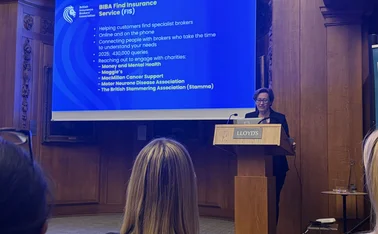
Biba chair calls on insurers to commit to signposting
Caroline Barr, chair of the British Insurance Brokers’ Association, has called on insurers to commit to signposting customers to specialist providers when the market fails to meet their needs.

Penny Black’s Social Diary: Hiscox and Howden's hole in one
Penny Black has been out and about again, notebook in one hand and canapé in the other, keeping a keen eye on the insurance industry’s more whimsical moments.

Jensten CEO Organ exits with Buesnel named successor
Rob Organ is to step down as CEO of Jensten Group, with Clive Buesnel appointed as his successor from 2 November 2026, subject to regulatory approval.
Howden chair steps down as listing edges closer
Howden has revealed that Dominic Collins will step down as executive chairman after 11 years in post.

Biba flood scheme pays £9m in claims over first decade
A specialist commercial flood insurance scheme from the British Insurance Brokers’ Association and Mi Specialty has paid more than £9m in claims to businesses over its first decade, with the scheme now covering £600m of assets.

Q&A: James O’Hara, AbbeyAutoline
James O’Hara, a Chartered insurance broker and senior manager at AbbeyAutoline, reveals how he achieved one of the Chartered Insurance Institute’s highest global accolades after topping the performance charts in his Fellowship examinations.

Marsh launches AI-powered broker tool
Marsh has launched Broker WorkBench, an artificial intelligence-powered platform designed to assist Marsh’s brokers operating in the London market in serving their clients.