
No more beating about the bush
historicalrisk_gif

Despite the confusion surrounding hedge funds, more companies seem to be increasingly aware of the benefits these funds have to offer

According to hedge fund managers there are two types of investors, those that have seen the benefits of investing in hedge funds and those that are yet to do so. Arrogant as this view sounds, it is undeniable that there has been a significant flow of top fund managers from traditional long-only investing to managing hedge funds.

In the insurance industry, certain companies such as Max Re and Renaissance Re are active users of hedge funds for a reasonable part of their portfolio, whereas many other firms in the sector do not use them at all. Indeed, a survey by the research working party from the institute of UK actuaries on absolute return funds revealed that only 16% of UK life assurance companies had hedge fund investments, while only a further 16% expect to make investments in these funds over the next three years.

Allocations to hedge funds were, however, very small and companies expected them to stay modest. Almost a third of investors stated they would never make an investment in a hedge fund, believing that they were inappropriate as a result of fees, risk profiles and transparency.

Although the insurance sector is only one segment of the investing population (albeit a fairly sizeable one) this contrasts starkly with a recent Pricewaterhouse Coopers (PwC) survey that suggests that up to 80% of investment managers either do, or are planning to offer hedge funds to clients. While this would not be the first time the asset management industry has failed to observe consumer demand before launching products, such a disconnect deserves investigating.

Increased portfolio efficiency

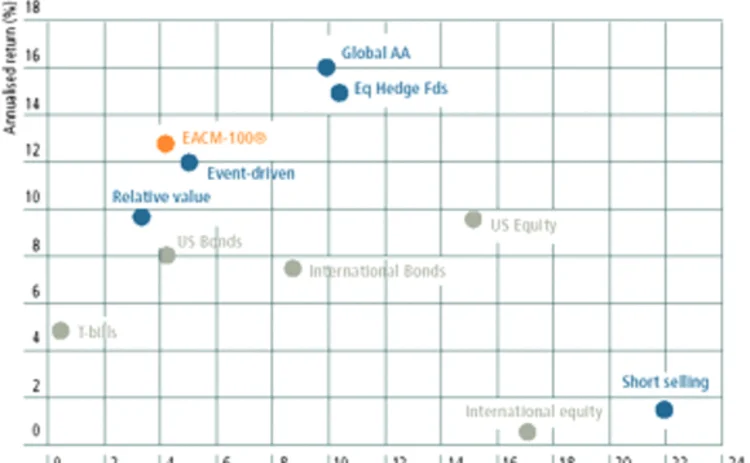
Investment theory demonstrates that allocating capital to investments with a low correlation to other asset classes, low volatility and consistent returns leads to a more efficient portfolio. This kind of portfolio will have a higher expected return for a given level of risk than a traditional one comprising only equities and bonds. The chart below highlights the historical risk and return characteristics of certain hedge fund strategies and other asset classes.

International equities have experienced annual volatility of approximately 17% and there have been three-year periods in which returns of as much as 26% a year and as little as -16% a year have been delivered. By contrast, the EACM100 Registered Mark, which is a composite hedge fund index, has demonstrated significantly lower volatility with higher returns that have been achieved more consistently.

Lacking transparency

Any sensible investor will want to understand a fund's investment strategy, while also having an insight into the corporation and people who are managing the money, and whether the performance and net asset values reported by the fund are genuine. This knowledge will allow the investor to identify problems early and to act on those issues that are considered unacceptable. It is up to the investor to decide which problems are severe.

For example, a manager who follows the wrong investment strategy, or who makes errors related to incompetence like over-leveraging the fund, may be given some grace provided he demonstrates willingness and effort in rectifying these problems. On the other hand, a manager who falsifies data, misvalues securities or commits fraud should be fired - provided that is possible, as many hedge funds restrict the ability of investors to redeem their money through lock-up clauses or penalties.

Apart from investment risks, there is the matter of operational risk. Hedge fund management companies are often small, newly formed operations, run by a small team of key individuals. Some of these firms may be undercapitalised and others may be incompetent. In a few cases, they may even be dishonest and before long something may go wrong and the investor's money disappears.

Losing the investment focus

Hedge fund managers may shun transparency if there is a chance that it will highlight deficiencies in their organisational structures. Many hedge fund management 'stars' started off being successful portfolio managers within a large asset manager or investment bank. In this environment they enjoyed the full support of that organisation's back office and infrastructure, allowing them to focus on making investment decisions. Now they are setting up a small hedge fund business and dealing with all the associated problems, such as managing people, organising office space, negotiating contracts and so on. As a result, their small businesses may have a noticeable lack of internal controls and may be prey to the authoritarian manager whose overall responsibility could include authorising trades as well as settlements. When things start going wrong it is not surprising that the lack of transparency and supervision that an offshore hedge fund allows, provide the ideal opportunity to commit extensive fraud.

Very real risk

But is all the fuss about operational risk justified? Presumably if only a small number of hedge fund failures are due to operational issues, then there is no need to worry about it too much. A survey carried out recently by a risk consultancy indicated that operational risks alone accounted for 50% of the failures among US hedge funds, while investment risk accounted for 40%. The remaining failures were due to a combination of factors. Therefore, operational risk is very real. Investors who sign up for management structures with little or no transparency have nobody but themselves to blame if it all goes wrong due to operational errors, which even elementary transparency might have picked up.

Justifying their position

Thinking about it, the only party who usually argues that transparency is unnecessary is the fund manager. This is usually because the particular strategy being run "must be kept secret". Managers cite a number of reasons for this, such as preventing other funds from copying or trading against positions, or because the effort and costs of maintaining transparency "detract from the main business of producing superior returns".

Some hedge fund managers may have genuine reasons for not wanting to publish their precise strategy or positions. They may be trading in illiquid securities, or have discovered a source of return unknown to others, so they want to safeguard their competitive advantage.

However, for many managers the lack of scrutiny is merely a thing of great convenience. It means lower compliance costs, more flexibility to change stated goals at will and freedom from restrictive investor guidelines - which cannot be enforced after all, if the investor does not know what is going on! At the extreme, it means the ability to hoodwink investors when the chips are down.

Taking a different path

In fairness to the hedge fund industry, many of the traditional fund management regions (domiciles) have not been very friendly towards hedge fund managers. In a nutshell, the rules drawn up for asset management are often inappropriate and quite restrictive from the hedge fund manager's perspective.

Against this background, the hedge fund industry has found itself naturally growing up outside of the traditional, regulated investment markets, in jurisdictions that have very limited requirements for providing information. In such regions, investment strategy can be very broad and it may be possible to write fund prospectuses that are designed to be as flexible as possible. This gives almost free reign to the manager with respect to what instruments they invest in and how much leverage they can use.

On balance, the operational risks associated with hedge fund investing are still too high for many insurers. The big question they face is whether it is prudent to send money to a lightly regulated offshore environment. At the same time, the hedge fund industry gives them access to talent and sources of investment performance that they would otherwise miss. Therefore, the key is to obtain this exposure but in a way where issues like poor transparency, poor liquidity and lack of regulation are addressed to an acceptable level.

Moving to the mainstream

As the PwC survey suggests, hedge funds are becoming mainstream. This is not necessarily because they are available to individual investors, although increasingly this is the case in many jurisdictions, but because many large traditional asset managers now offer hedge funds to investors. You could say, hedge funds are becoming institutionalised.

Traditional asset managers are offering hedge funds for a number of good reasons, not least because they must retain their talented managers. Moreover, the fees they can generate are significant for funds that perform well and they have seen strong demand from their clients. Hedge funds now account for a significant proportion of many asset managers' business operations. For instance, Man Group has built a significant hedge fund business and is capitalised at £4.56bn ($7.96bn), ranking it 47th within the FTSE 100 Index. Barclays Global Investors runs a thriving hedge fund business that is now one of the largest in Europe.

Such larger managers cannot risk the damage a hedge fund blowing up would inflict upon the rest of their business, so they are acutely aware of the need for transparency and proper internal risk controls.

Sizing up the options

Some hedge fund managers are very small and under-resourced firms, operating with the bare minimum of disclosure, investor communication and risk management. Others are well managed and have proper compliance and risk management controls in place. Often it is the larger firms who can afford to have these additional systems and people.

An investor could restrict investment to those hedge funds run by institutions that have strong internal controls, effective compliance procedures, robust finances and appropriate investor communication. Finding these firms may involve some research and homework by the investor. Alternatively, the investor could seek out those firms that are appropriately regulated, for example, by the US Securities and Exchange Commission, the Central Bank in Ireland or the UK's Financial Services Authority.

The firms selected should be able to demonstrate their controls in an explicit manner. Investors could ask to see how risk reports are produced, or who is involved in compliance enforcement to make sure these people are independent from the investment decision-making team. The more transparent the organisation's structure, the easier it will be to make these assessments.

Factoring in the fees

Another core area of concern for institutional investors is the level of fees charged by hedge funds. As many insurers are accustomed to low, double-digit, active bond or indexed, equity fund fees, hedge fund fees that are in excess of 100 basis points with an additional 20% performance fee on top come as a bit of a shock.

Unsurprisingly, hedge fund managers argue that such charges are not excessive, mainly because the investor should focus on net returns. If you take this argument one step further, you come to the issue of net risk-adjusted returns.

There have been widespread suggestions that long-only investment funds should also be more geared to performance fees. However, with the bounce in the equity markets, investors have gone relatively silent on this issue. Whatever your view, performance fees do align a manager's and investor's incentives. Moreover, while at first glance many hedge funds' fees may appear high, the number of these vehicles that have reached capacity indicates that this does not dampen demand.

Daunting market

With more than 6000 hedge funds available and a myriad of investment strategies and processes, this market can appear complex and inaccessible. In addition, many funds are now closed to new money, while some of the best funds available rely upon word of mouth to attract new investors. It can appear to be a closed shop for new investors, so how can the uninitiated break into this market?

Many investors now delegate the selection and monitoring of a hedge fund to a specialist investment manager. This can either be on a consultancy type basis, or through the use of a fund of hedge funds structure, which have become increasingly popular over the past few years. These 'managers of managers' aim to allocate the investor's capital to the most appropriate investment strategies and underlying investment managers. They will also seek to address concerns such as transparency and limited capacity, through pre-existing relationships with preferred hedge fund providers.

Fund of hedge funds are attractive to many investors as there are significant differences between first quartile and last quartile investment performance, which a diversified portfolio seeks to smooth or eliminate.

Investing through a fund of hedge funds does add an extra layer of fees to the end investor. Also, for those investors who like to feel close to the ultimate investment manager, they will no doubt feel as though an element of control and contact has been sacrificed. From the investment manager's perspective, hedge fund of funds are generally easy and straightforward to deal with and can draw significant assets into their funds.

Ultimately it comes down to education and knowledge. Hedge funds can be an extremely useful investment tool that offers performance and risk diversification benefits. They are, however, extremely difficult to model and manager selection requires careful due diligence. Therefore, the same maxim that applies in many walks of life applies to hedge fund investing, or as Gary Player famously put it: "The more I practise, the luckier I get."


Only users who have a paid subscription or are part of a corporate subscription are able to print or copy content.

To access these options, along with all other subscription benefits, please contact info@postonline.co.uk or view our subscription options here: https://subscriptions.postonline.co.uk/subscribe

You are currently unable to copy this content. Please contact info@postonline.co.uk to find out more.

Storm damage claims test insurers’ settlement choices

A year of severe storms has strained repair networks and claims operations, which Ben Blain, head of property at Verisk Claims, points out has placed insurers’ settlement decisions, data oversight and ability to evidence fair customer outcomes firmly under the regulatory spotlight.

How should success of FCA’s response to Which be judged?

The effectiveness of the Financial Conduct Authority’s regulatory action in response to Which’s super-complaint about home and travel insurance is reflected in smoother claims handling, not in the number of reviews or fines, according to Claire Massey, founder of Claim Guardians.

Most read articles loading...

You need to sign in to use this feature. If you don’t have an Insurance Post account, please register for a trial.

Sign in
You are currently on corporate access.

To use this feature you will need an individual account. If you have one already please sign in.

Sign in.

Alternatively you can request an individual account here