

Smaller slices of PI
Professional indemnity insurers are continuing to underachieve because of outdated methods, believe Raj Ahuja and Robin Milner. A closer analysis of pricing and claims reserving is vital
After years of bleeding red ink, professional indemnity insurers may at last be returning healthy profits - but that does not mean they are making the most of their opportunities.
Hard markets tend to disguise flaws, only for them to be exposed at a later stage. To make the most of the good times and remain in the black when the cycle eventually turns, underwriters need adequate systems to rate and monitor the business they write. But experience suggests that too many PI insurers have not understood the dynamics of their portfolios.
As a result, they are unwittingly subsidising their weakest market segments and failing to take full advantage of their strongest.
One-way not the right way?
The problem from the rating viewpoint is that analysis is not performed in sufficient detail, usually using too few rating factors and without consideration of how these factors interact with each other. This should concern not just direct insurers, but also those using coverholder or managing general agent arrangements, where there has traditionally been a scarcity of timely data. It is no coincidence that Lloyd's continues to issue strict guidelines for the control and monitoring of MGAs' arrangements.
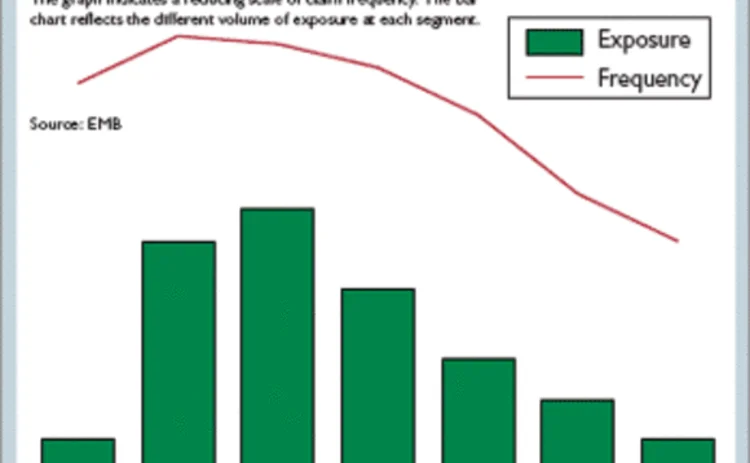
Rating is normally performed by modelling the claims using 'one-way' tables. This is where claim numbers and amounts are summarised against exposure for each rating factor individually (see Fig 1). But this approach can be misleading. Different mixes of business and interaction between rating factors can distort the results. For example, a larger company may have a higher retention: so are differences in claim frequency the result of their size, or their retentions?
The inappropriate use of one-way tables, and the associated failure to subdivide the rate book into the appropriate segments as defined by rating factors, has many adverse consequences. Some segments are priced too cheaply and are, therefore, unprofitable; other segments are priced too highly and the insurer risks losing business.
This makes it possible for insureds and competitors alike to take advantage of inconsistencies in PI insurers' rate books. Furthermore, their underwriters can only guess at the statistical variability between the key factors that influence the claims within the business they write.
The solution is to price business at the 'micro' level to expose relative claims experience between different segments, as is already common in personal lines insurance. This is done using generalised linear models, where a regression model is fitted to all rating factors simultaneously.
The effects of each factor can then be isolated. Claims frequency and claims severity are modelled individually to provide greater understanding of the processes underlying the risk premium per policy (see Fig 2). This approach has the additional benefit of simplifying over-complicated rating factors by grouping them and also removing any irrelevant factors. Hence the process will 'clean up' the rating factors already in use. A further advantage is that GLMs provide a more rigorous statistical framework from which to base rates. They also allow the exploration of combinations of different rating factors.
Another point in relation to pricing is that PI claims need to be considered in size bands. The issues surrounding these claims have to be dealt with separately and the risk premium allocated to the appropriate sector of the portfolio. For example, the risk premium from basic claims is attributable to an individual rating factor level, while the large claims cost can be smoothed over a broader range, perhaps involving only a few rating factors. The cost of 'mega-claims' is then spread across the entire portfolio.
Several actuarial software packages are now available to perform such analyses quickly and efficiently. The next step is to identify the profitable and unprofitable segments of the book and determine potential changes, enabling the premium rating structure to be adjusted accordingly. Once again, software packages can assist with such 'impact analysis'.
One advantage of this methodology is that it does not require the insurer to collect vast amounts of additional data from potential insureds, since most of the information for these additional rating factors is collected within the current quotation systems.
Attention to claims
Inadequate monitoring, including claims reserving, can compound the problems stemming from a poor rating structure. Claims are usually not monitored often enough, or not at the correct level of detail. Reserving should be analysed at as detailed a level as the rating process, and conducted on at least a quarterly basis. This will prevent problems within the account and help PI insurers to identify pockets of unprofitability. Conversely, if they fail to do so, business written could be making losses for a sustained period before the truth is finally discovered.
A change in expected claim amounts, and hence risk premium, can arise from many areas, ranging from segment-specific issues to economic factors affecting all segments. These trends can be hidden within data, but detailed monitoring will bring them out. To achieve this, it is imperative that a departure from the expected loss amount is identified early so the rating plan can be adjusted before losses escalate.
Although some of these processes may seem technical, the message is simple.
The greater understanding underwriters have of their portfolios, the greater their competitive advantage. The disciplines outlined above can have a direct impact on your bottom line - whatever the state of the market.
Only users who have a paid subscription or are part of a corporate subscription are able to print or copy content.
To access these options, along with all other subscription benefits, please contact info@postonline.co.uk or view our subscription options here: https://subscriptions.postonline.co.uk/subscribe
You are currently unable to print this content. Please contact info@postonline.co.uk to find out more.
You are currently unable to copy this content. Please contact info@postonline.co.uk to find out more.
Copyright Infopro Digital Limited. All rights reserved.
As outlined in our terms and conditions, https://www.infopro-digital.com/terms-and-conditions/subscriptions/ (point 2.4), printing is limited to a single copy.
If you would like to purchase additional rights please email info@postonline.co.uk
Copyright Infopro Digital Limited. All rights reserved.
You may share this content using our article tools. As outlined in our terms and conditions, https://www.infopro-digital.com/terms-and-conditions/subscriptions/ (clause 2.4), an Authorised User may only make one copy of the materials for their own personal use. You must also comply with the restrictions in clause 2.5.
If you would like to purchase additional rights please email info@postonline.co.uk
More on Commercial

Markerstudy targets £200m GWP as it relaunches ‘simplified’ commercial business
Markerstudy Business, the commercial insurance division of Markerstudy Group, is now fully “open for business,” and is targeting £200m in gross written premium.

Hantavirus outbreak raises complex insurance questions
The hantavirus outbreak onboard MV Hondius has exposed the legal, operational and insurance challenges facing cruise operators when infectious disease incidents escalate across multiple jurisdictions, according to Alexandra Pearson, member of the travel sector focus team of the Forum of Insurance Lawyers.

How the war with Iran will rip through insurers’ balance sheets
Editor’s View: From soaring claims inflation and disrupted supply chains to cyber threats, travel chaos and potential power outages, Emma Ann Hughes outlines how the Iran conflict could reshape underwriting, pricing and profitability for years to come.

Hiscox ‘pulling back’ from property risk
Hiscox has revealed it is pulling back from property because of high underwriting risks.

Aviva hires 15 regional specialty underwriters
Aviva has hired 15 new regional specialty underwriters in a move it says will give brokers faster access to local knowledge and specialist expertise.

Verisk to focus on joined-up thinking in new UK and Ireland unit
Joining claims and underwriting together under one brand will help Verisk provide insurers with better insight, according to Chris Sawford, managing director of Verisk General Insurance UK and Ireland.
Throwback Thursday: Computer insurance and bounce back plans
Insurance Post’s Throwback Thursday steps back in time to May 1981 to remind you what was going on this week in insurance history when Hogg Robinson launched computer insurance and General Accident was looking beyond the recession.

Companies House breach tests fraud and insurance cover
Paul Wainwright, member of the fraud sector focus team at the Forum of Insurance Lawyers and partner at law firm Browne Jacobson, examines how a security flaw at Companies House could expose directors and insurers to complex, overlapping risks.