
Behind the mask
As Sars threatens to re-emerge, what lessons can (re)insurers learn about managing emerging risks?
By Isobel McCalman.
The World Health Organisation (WHO) believes the severe acute respiratory syndrome (Sars) outbreak from November 2002-May 2003 resulted in 2702 cases and 435 deaths worldwide. When compared with the estimated 3-5 million cases of influenza every year, resulting in 250,000 to 500,000 deaths, Sars is clearly on a very different scale. However, the fact that it was a virtually unknown strain of respiratory illness that caused such widespread disruption means it provides a useful guide to the capacity of the (re)insurance industry to manage emerging risk and roll out a response in an effective timeframe.
A new outbreak of the Sars virus in 2004 was always likely and some cases have already been reported in China. There has been a marked difference in the response to the outbreak and the WHO has praised the Chinese government for its prompt action in dealing with the cases. Other risks are emerging however, with reports of a strain of avian influenza, which is developing in Vietnam. WHO says that every case of transmission of an avian influenza virus to humans (there have been three cases in Hanoi so far) is a cause for "heightened vigilance and surveillance". The potential risk is that a new virus could form to which humans have little if any protective immunity.
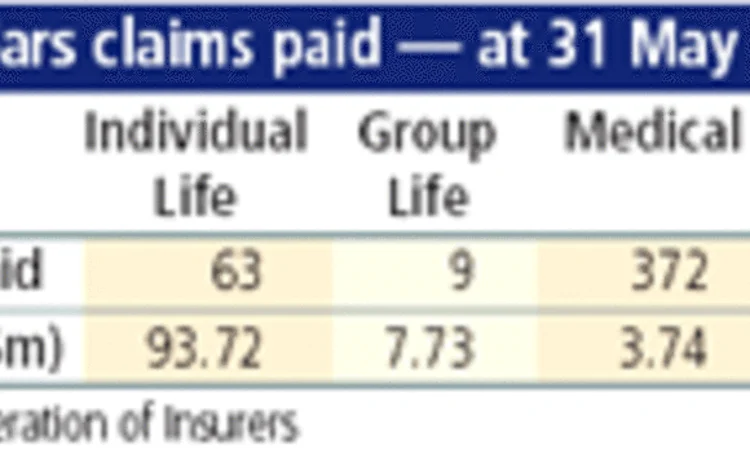
The impact on the (re)insurance industry of last year's Sars outbreak was varied. As well as having to manage a response in terms of insurance coverage, there was also the claims management and product demand. In Hong Kong, where there were 898 cases and 179 deaths, 492 Sars claims were settled as of 31 May 2003. The vast majority of the HK$105.28m ($13.56m) payout was for life insurance where there were 72 claims; within this there may have been multiple claims on one victim. The only payout to be bigger for Hong Kong insurers was Typhoon York in September 1999, which led to a payout HK$290.91m. On the commercial side, the hotel chain Mandarin Oriental International settled on a claims figure of $16m for losses arising from business interruptions (see table).
Although these figures are sizeable they are not exceptional in themselves considering Munich Re's figures show that storms in the American mid-west in May alone caused $3.2bn in insured losses. The more important issue is the 'new' nature of the claim and how insurers manage and source reinsurance solutions for the unexpected nature of the risk. The issues surrounding illness and health cover epitomise the difficulties faced by (re)insurers in meeting an insurance need while maintaining an underwriting structure which is profitable and sound. Suzanne Douglas, managing director, Willis' property practice, says of risk that lies outside of the realm of traditional insurance: "The key to success lies within the company itself. It must have clearly outlined the exposures and developed and validated a business continuity plan to sufficiently mitigate them. Brokers, working with certified business and others who tap into the reinsurance/capital markets, are creating highly individualised solutions to protect the specific earnings streams exposures of companies against 'intolerable risks'."
Varied exposure
As the Hong Kong experience shows, the life insurance exposure can be reasonably limited in the case of a disease such as Sars. Despite the slow initial reaction to the virus, once it was identified quarantine was a reasonably effective method of stopping its spread. For the underwriter, the property and casualty risk portfolio is far more diverse and potentially exposed. In a quarantine situation business interruption is an immediate risk. Denial of access, business interruption to suppliers and customers, and first-party clean-up costs are all potential claims. Related to this is the risk to specific events that may have to be cancelled or abandoned.
Travel restrictions and a general fear of the potential hazards had a big impact on Asia. The cancellation of the Rolling Stones concerts in the area was put down to their inability to get insurance. For event organisers, cover is now more expensive and exclusions are being written in for Sars or even communicable diseases.
This effective withdrawal from a market is difficult for the (re)insurance industry and highlights the wider implications of emerging risk. Cliff Titcomb, vice-president and chief medical director for ING Re's individual life and health operation, says: "Pulling out of markets or limiting face amounts could reduce new exposures but would severely affect producers and not address the issue of policies in force. In short, the protection offered by traditional risk selection and mortality management techniques is minimal."
Workers' compensation or worker's liability is another area that the emergence of SARS challenges. Health workers are the first group at risk but the potential for a much wider group of workers to become perceived as 'at risk' within the work environment is considerable - airport personnel is one example. In the more general sense, public liability is a potentially significant exposure. Hotels, restaurants, hospitals, shopping areas and all sites where people congregate could be vulnerable and the duty of care issues could mean large and unexpected payouts. The Sars situation showed that the risk could not be assessed using traditional actuarial methods alone and, going forward, a system of assessment and early warning is required. Donna Galer, executive vice-president, Zurich Financial Services, advocates an "enterprise-wide risk management" approach in which she says that everyone in the insurance chain needs to look at risk management "through a very wide lens".
US challenge
For the US market, Sars did not have a direct impact but the issues in terms of risk management are just as relevant. The risks of a disease that has the appearance of a cold or flu are of particular concern in a country with a large number of people with no health care cover. The National Coalition of Health Care says approximately 41.2 million Americans were without insurance in 2001 and this is predicted to rise to 51.2-53.7 million by 2006. This makes the likelihood of a disease spreading because of a lack of treatment, especially in poor areas, much higher. Age is also a factor; during the Sars outbreak, the mortality risk was more than 50% among those aged over 65. Mr Titcomb says this mortality pattern shows the vulnerability of the insurance industry because of its financial concentration of risk: "Increasing numbers of large policies are being issued to older individuals, precisely the group at highest risk from the disease. Thus a significant outbreak of Sars in the US has the distinct possibility of producing a large dollar amount of life and health claims, even if the number of events is modest."
Swiss Re's chief risk officer Bruno Porro says: "We have to implement the lessons that we learned from Sars." This is a view echoed by CF Choy, chief executive of HSBC Insurance, Hong Kong, who argues that insurers must handle policy changes and restrictions resulting from new risks very carefully or risk losing customers' trust - and their business. There are already signs that the specific Sars risk is being addressed and coverage is available, particularly in the countries most affected last year. However, the General Insurance Council of the Hong Kong Federation of Insurers has said that from 1 January 2004 only a "limited supply of employees' compensation insurance for the medical profession" will be available as "a result of prudent risk management". It goes on to say: "Reinsurers are making it clear that infectious diseases can only be covered on a person-by-person basis. Insurers are therefore faced with the burden of unknown risk of loss accumulation as they must carry the first part of an individual claim themselves." Hong Kong employers have a statutory requirement to provide employees compensation protection so there is a real risk that there will not be enough cover.
Sars and other developing diseases such as West Nile virus are a continuing issue for underwriters. The broader view puts it in the context of global warming which shows just how far-reaching an issue it is. Dr Paul Epstein, associate director at the centre for health and the global environment at Harvard medical school, says: "The intense weather extremes associated with warming of the atmosphere and oceans create conditions favourable to 'clusters' of disease outbreaks. Large outbreaks of West Nile virus in the US and Europe are associated with drought and prolonged droughts have become more frequent with global warming." Mr Titcomb says: "To a large extent, insurers are along for the ride with Sars and must hope that the long-term adverse results of the disease remain limited. The worst case scenario is that a more significant economic result for insurers could affect profitability and force the industry to turn pricing and capacity issues to limit risk."
While this is true of most emerging risks it is also true that detecting emerging risks as quickly as possible, and understanding them from a technical, economic and social perspective, gives the best hope of being able to customise insurance products appropriately. By risk profiling thoroughly at the earliest possible opportunity there is also the potential to control accumulation for both reinsurers and cedants while improving the risk-cost calculation. This process is certain to be a cornerstone of the (re)insurance business as the risk of Sars and other new diseases are only more likely to emerge.
| Prion infection risk | |
| • A new report by Swiss Re has found that the risk of being infected while in hospital by new varient Creutzfeldt-Jakob disease (vCJD), the human form of BSE, has increased. The risk of the disease, which is caused by infectious prions which gradually destroy the brain, is particularly high because the prions are extremely resistant to conventional methods of cleaning and sterilisation. The risk assessment is made more complex because organs may be affected for a long time before the first signs of the disease appear. Given that the disease was only identified in 1996, there is no way of knowing how many people are already infected or accurately predicting how the disease will spread. To date there have been 100 deaths from vCJD since 1996. The report considers that insurers cannot wait for more specific information: "It must produce scenarios which enable it to act early to the possible consequences of the risk. The crucial factor in this connection is not just the number of unknown infected individuals at a given time, but the risk of multiplication by the hospitals." • The report calls for risk minimising measures within hospitals but also calls for a rethink in the ways they take on risk management principles and increase patient safety. From the insurers point of view the insurability of hospitals is already difficult. Despite increases in premiums, hospital liability insurers in all the major European countries still have massive deficits and some insurers have pulled out of the market. Swiss Re claims that unless there is a systematic incorporation of risk management into the corporate culture, the trend will not change. However, it also points out that if a hospital does take steps to minimise the risk then it has to see a corresponding insurance advantage, compared to hospitals that have not. |
Only users who have a paid subscription or are part of a corporate subscription are able to print or copy content.
To access these options, along with all other subscription benefits, please contact info@postonline.co.uk or view our subscription options here: https://subscriptions.postonline.co.uk/subscribe
You are currently unable to print this content. Please contact info@postonline.co.uk to find out more.
You are currently unable to copy this content. Please contact info@postonline.co.uk to find out more.
Copyright Infopro Digital Limited. All rights reserved.
As outlined in our terms and conditions, https://www.infopro-digital.com/terms-and-conditions/subscriptions/ (point 2.4), printing is limited to a single copy.
If you would like to purchase additional rights please email info@postonline.co.uk
Copyright Infopro Digital Limited. All rights reserved.
You may share this content using our article tools. As outlined in our terms and conditions, https://www.infopro-digital.com/terms-and-conditions/subscriptions/ (clause 2.4), an Authorised User may only make one copy of the materials for their own personal use. You must also comply with the restrictions in clause 2.5.
If you would like to purchase additional rights please email info@postonline.co.uk